

close
Choose Your Site
Global
Social Media




| Quantity: | |


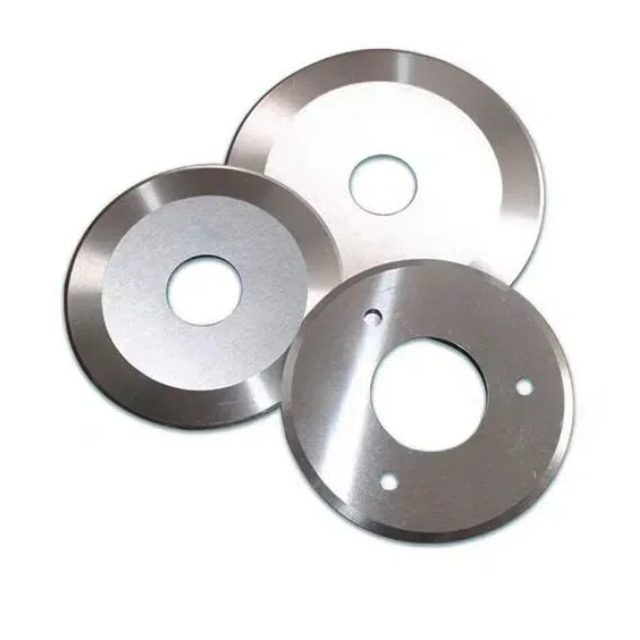
As a core component in the industrial slitting field, the circular blade of a slitting machine, with its rotary cutting structure, enables efficient and precise slitting of various rolls and sheets, and is widely adaptable to automated production lines and stand-alone operation scenarios. With "low resistance, high precision, and long lifespan" as its core characteristics, through scientific material selection, precise structural design, and stringent manufacturing processes, it provides stable and reliable cutting solutions for the slitting needs of different industries, and is an important support for improving production efficiency and ensuring the quality of finished products.

Utilizing Swiss-type sliding headstock lathes, five-axis CNC tool grinders, and other equipment, we achieve precision forming of the outer diameter, end face, and cutting edge. The surface roughness can be controlled within Ra0.1μm, the thickness tolerance reaches ±0.001mm, the cutting edge straightness is ≤0.05mm/m, and the cutting error can be precisely controlled within ±0.2mm, ensuring a smooth and clean cut without burrs or rough edges.
After multiple forging, quenching, tempering, and deep cryogenic treatment with liquid nitrogen at -196℃, the residual austenite is transformed into martensite, increasing the hardness by 3-5 HRC while enhancing dimensional stability and preventing deformation during use. Some materials undergo oil quenching at 980-1035℃ and tempering at 150-370℃ to effectively avoid the brittle range.
PVD coating, nano-coating and other technologies can be used to reduce the friction coefficient of the blade, inhibit crack propagation and extend the service life by 2-3 times; laser correction of the blade body mass distribution completes G2.5 level dynamic balance verification, and the vibration value is controlled within 0.5μm at a speed of 30,000rpm, making it suitable for high-speed operation scenarios.


