

close
Choose Your Site
Global
Social Media
High-speed poultry processing lines operate on razor-thin margins. Utilizing the wrong blade geometry or material directly correlates to meat tearing, reduced yield, and costly maintenance downtime. Upgrading or replacing a Poultry Processing Blade isn't a one-size-fits-all procurement task. It requires matching blade metallurgy, edge profile, and OEM compatibility to specific line operations.
This guide breaks down the different types of Poultry Cutting Blade tools by application, edge geometry, and material. You will discover a technical framework to evaluate and source the exact tooling needed to optimize your production line. We will explore how specialized coatings, precise tooth pitches, and custom reverse-engineering solve chronic throughput bottlenecks.
No single blade suits all operations; selection must be mapped to specific stages (e.g., rigid circular blades for slaughter, flexible curved blades for deboning).
Edge profiles (straight, scalloped, serrated) dictate cut quality; improper edge selection leads to product waste and bacterial harborage points.
High-carbon stainless steel paired with anti-friction coatings (TiN, DLC) provides the best balance of edge retention and FDA-compliant sanitation in high-moisture environments.
Custom-engineered blades can often resolve chronic yield issues found when using standard OEM replacement knives.
Selecting industrial knife profiles directly dictates your daily profitability. Plant managers often underestimate how deeply inferior steel impacts operational metrics. You must evaluate these tools strictly on performance data.
Dull or improperly specced blades tear muscle fibers instead of severing them cleanly. This tearing action drastically reduces Grade-A product yield. Torn breast meat drops into lower-tier pricing categories instantly. Ragged cuts also expose more surface area to oxidation. This reduces the shelf life of the packaged product. Your primary goal is achieving razor-clean slices to maximize premium weight output.
Frequent changeovers due to poor edge retention stall automated lines. Every minute spent swapping a dull knife stops hundreds of birds from moving forward. Success criteria for a new blade should include a measurable increase in mean time between replacements (MTBR). Better edge retention means fewer shift interruptions. It allows maintenance teams to focus on preventative care rather than emergency tool swaps.
Food safety regulations mandate strict equipment hygiene. Micro-fissures in cheap steel create bacterial harborage points. Poorly designed serrations also trap raw proteins. Evaluators must prioritize food-grade finishes and easy-to-sanitize geometries. Microbes like Salmonella thrive inside microscopic scratches. High-quality steel resists harsh chemical washdowns daily without pitting or rusting. Compliance heavily depends on using structurally sound materials.
Best Practices for Compliance:
Inspect edges daily for micro-cracks.
Use high-pressure sanitizing nozzles specifically targeted at serrated gullets.
Discard any knife showing visible signs of oxidation immediately.
Different anatomical challenges require unique mechanical solutions. Bones, tendons, skins, and soft tissues react differently under pressure. You must map your tooling precisely to the production node.
Slaughter and Evisceration (Vent Cutters):
Tooling: Precision-ground, beveled circular slicers and gizzard cutters.
Requirements: High-speed rigidity to replace manual operations. These environments expose metals to severe organic acids. The knife must withstand constant exposure to bodily fluids without corroding. It requires an incredibly robust center bore to prevent wobble at high RPMs.
Cut-Up and Portioning (Bandsaws and Circular Knives):
Tooling: Butcher bandsaw blades and scalloped circular blades.
Requirements: For bone-in processing, tooth pitch is critical. A standard rule applies here. Use 3 TPI (Teeth Per Inch) for frozen or heavy bone cuts. Use 4 TPI for fresh carcass splitting. Improper pitch causes bone splintering. Splinters ruin product quality and introduce choking hazards.
Deboning (Breast, Leg, and Wing):
Tooling: Curved, notched, and flexible straight blades.
Requirements: Blades must flex to hug bone contours tightly. This maximizes meat recovery without chipping the blade. A rigid blade leaves valuable meat attached to the carcass. Operators rely on calculated flexibility to scrape bones clean rapidly.
Skinning and Derinding:
Tooling: Razor-sharp, ultra-thin skinner blades.
Requirements: You often customize these tools using specific left or right bevels. They must cleanly separate skin without damaging the underlying tissue. They must never clog the machinery. A clogged skinner stops the entire portioning line instantly.
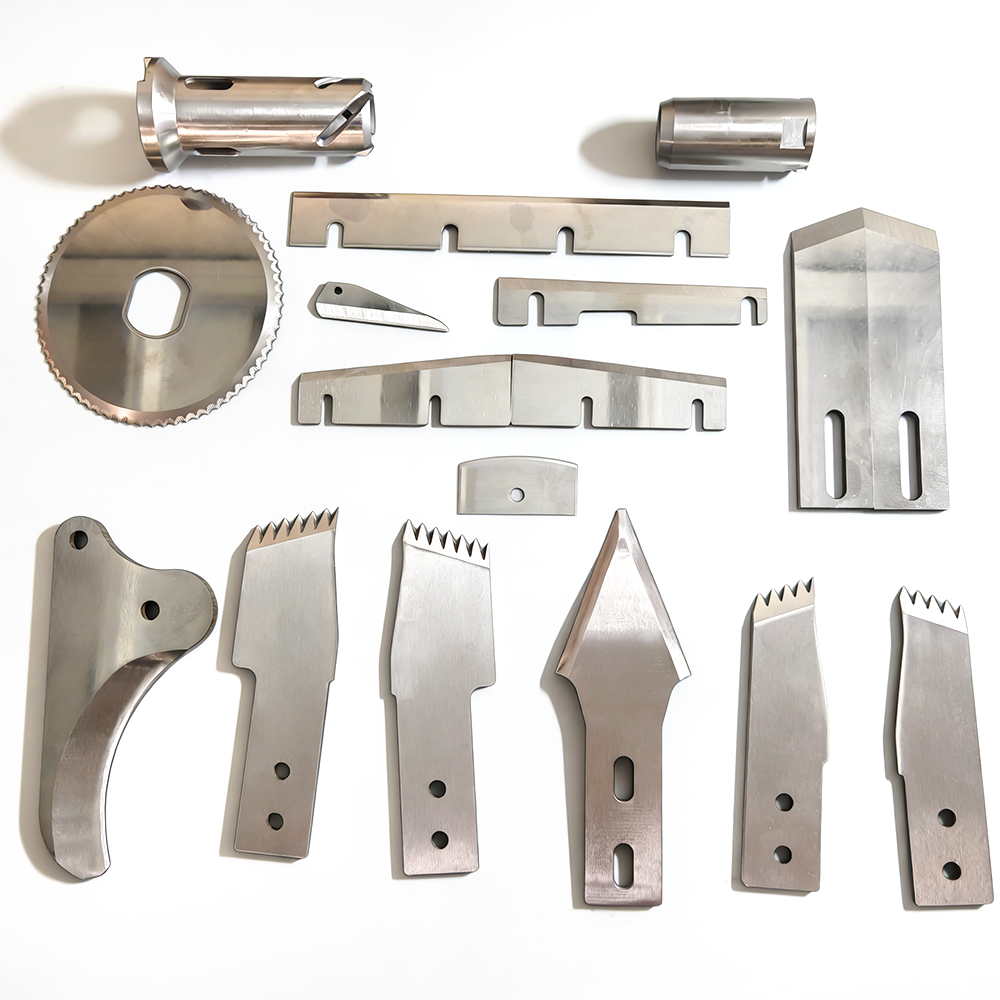
Edge geometry dictates how metal interacts with poultry fibers. Using the incorrect profile increases friction. High friction generates heat. Heat causes sticky proteins to adhere to the steel.
| Edge Profile | Primary Application | Operational Advantage | Maintenance Consideration |
|---|---|---|---|
| Straight / Knife Edge | Further-processing, clean slicing | Leaves the smoothest surface finish | Requires frequent, daily honing |
| Scalloped / Wavy Edge | Boneless meats, deli cuts, skin-on | Prevents meat sticking, protects sharp points | Easier to maintain than deep serrations |
| Toothed / Serrated | Tough tendons, cartilage, heavy bone | Aggressively grips and rips dense tissue | Requires specialized factory resharpening |
| Notched & Slotted | Automated machinery (wing segmenters) | Prevents blade drift under high torque | Must perfectly match OEM hub specs |
This profile works best for clean slicing in further-processing stages. It cleanly parts soft muscle without resistance. It requires frequent honing but leaves the smoothest finish. Consumers expect this visual perfection on premium breast fillets.
You will find this ideal for portioning boneless meats, deli cuts, and skin-on poultry. The continuous waves protect the sharpest points of the blade. This geometry extends lifespan significantly. It also creates tiny air pockets during the cut. These pockets prevent sticky meat from clinging to the steel block.
Engineers design these to aggressively grip and rip through tough tendons, cartilage, and bone. They bite into slippery joints securely.
Implementation Risk: They prove much harder to sharpen in-house. They require rigorous cleaning protocols to maintain hygiene. Organic matter easily wedges between the tight micro-serrations.
These represent custom geometries. We engineer them to lock securely into specific OEM automated machinery. A wing segmenter applies immense rotational force. Notches prevent dangerous blade drift under high torque. Precision mounting holes ensure perfect concentricity during rapid spins.
Poultry processing creates a highly corrosive environment. Blood, fat, saline solutions, and industrial sanitizers degrade raw metal constantly. Selecting the correct substrate prevents catastrophic tool failure.
Alloys like the 400 series or 304 represent the industry standard. Evaluators must balance hardness against toughness carefully. Hardness keeps a sharp edge much longer. Toughness resists chipping when hitting solid bone. High-carbon stainless steel provides this exact sweet spot. It flexes slightly under pressure without snapping.
Common Mistake: Choosing a blade strictly for maximum hardness. Extreme hardness creates brittleness. A shattered blade contaminates an entire meat batch instantly.
We use this material for highly specialized, automated cuts. These cuts require extreme wear resistance. Carbide outlasts standard steel by vast margins. However, it is significantly more brittle than steel. You only use it in rigid, vibration-free machine hubs where impact shocks remain minimal.
Uncoated steel generates friction drag. Advanced surface treatments eliminate this issue entirely.
Titanium Nitride (TiN) & Chromium Nitride (CrN): These applied layers reduce friction massively. They prevent sticky poultry proteins from adhering to the blade surface. Less adhesion means cooler cuts. This extends the time between required sharpenings.
FDA Compliance: Any coating evaluated must be certified food-safe. It cannot flake off into the product. It must resist harsh chemical washdowns without degrading over time.
Procurement teams face a constant choice. Do you buy standard catalog parts or invest in engineered solutions? The correct answer depends entirely on your specific production bottlenecks.
Standard replacement blades provide a comfortable path. They are guaranteed compatible with major processing equipment brands. Common machines include Stork Gamco, Meyn, Foodmate, and Simmons. This route feels safe and predictable. However, these parts act as generic commodities. They perform adequately but rarely offer breakthrough efficiency gains.
You should choose this path when standard blades cause recurring bottlenecks. Partnering with a skilled manufacturer allows for deep reverse-engineering. They work directly from CAD drawings or worn samples. They adjust specific bevel angles, alter blade thickness, or apply specialized coatings. A minor tweak to a bevel angle can save thousands of pounds of meat annually.
If moving to a custom blade, you must evaluate the supplier’s structural ability. Can they maintain tight CNC tolerances across bulk orders? A prototype might work flawlessly. However, a bulk run with loose tolerances will cause automated machinery to jam. Consistent metallurgical heat treatment separates elite suppliers from amateur machine shops.
Switching knife vendors carries inherent production risks. You mitigate this risk by auditing the supplier's technical capabilities rigorously. Do not rely solely on pricing catalogs.
Does the vendor offer low-quantity sample runs? Quality partners provide on-site engineering support. They help you test edge retention in real-world conditions before a bulk rollout. You need proof of concept. They should analyze your worn blades under magnification to identify exact failure modes.
The cost savings of a cheap blade disappear instantly if lead times cause line stoppages. Assess the vendor's domestic stocking capabilities. Demand clear "quick turnaround" guarantees. Just-in-time manufacturing requires suppliers to hold safety stock for your specific part numbers.
Look for completely transparent manufacturing processes. Reputable brands manage in-house heat treatment. They utilize highly precise CNC grinding equipment. Avoid third-party white-labeling vendors. Brokers cannot control microscopic quality variations. Direct manufacturers stand behind their metallurgical integrity.
| Supplier Evaluation Metric | Warning Sign (Red Flag) | Ideal Standard (Green Flag) |
|---|---|---|
| Engineering Support | Refuses to alter OEM designs | Offers reverse-engineering & CAD analysis |
| Manufacturing Origin | Acts purely as an import broker | Owns CNC and heat-treatment facilities |
| Material Testing | Cannot provide steel hardness specs | Provides exact Rockwell Hardness (HRC) reports |
Selecting the right tooling remains a highly strategic decision for modern plant operations. You must successfully balance metallurgy, edge geometry, and the specific processing stage. Rigid vent cutters require vastly different engineering than flexible breast deboners. High-carbon stainless steel offers dependable baseline performance, while advanced TiN coatings solve sticky friction issues.
Action Steps:
Encourage your procurement and plant managers to audit highest-wear production nodes this quarter.
Collect badly worn or chipped blades from the discard bin to analyze failure patterns.
Consult with an industrial blade manufacturer to test alternative coatings or altered edge profiles.
Track MTBR (Mean Time Between Replacements) rigorously to prove the ROI of upgraded materials.
A: High-carbon stainless steel represents the optimal choice. It offers the perfect balance of edge retention and necessary flexibility. Operators often pair it with anti-stick surface coatings like Titanium Nitride (TiN). This prevents slippery proteins from building up, allowing the flexible blade to hug bone contours without snapping.
A: Your choice depends entirely on the meat's state. We highly recommend using 3 TPI for frozen poultry or heavy bone-in applications. It clears dense chips rapidly. Alternatively, utilize 4 TPI for much smoother cuts on fresh poultry carcasses to prevent excessive meat tearing.
A: Serrated profiles feature deep gullets between the teeth. These narrow spaces easily trap raw fat, tissue, and bacteria. Straight-edge blades wipe clean easily. Serrated tools must be subjected to high-pressure, targeted washdowns and aggressive chemical sterilization to ensure dangerous microbes do not multiply inside the crevices.
A: Yes, absolutely. Reputable industrial blade manufacturers routinely reverse-engineer standard parts. They optimize the metal thickness, edge angles, and coatings while maintaining exact mounting hole dimensions. These custom upgrades fit precisely into standard OEM equipment slots without requiring any machine modifications.


